
Skill-Based Education vs Traditional Education: Which Path Leads to Your Future Success? 🚀
Introduction
Hello, brilliant minds! 👋 Have you ever found yourself wondering why you're memorizing complex formulas or historical dates, while also feeling a pull to learn something more hands-on, like coding, digital marketing, or graphic design? You're not alone. The world of education is undergoing a massive transformation, and it's sparking a fascinating debate: Skill-Based Education vs. Traditional Education.
For decades, the traditional path—focused on textbooks, exams, and degrees—has been the gold standard. 🎓 But today, the job market is demanding something different: practical abilities and adaptability. This isn't just about choosing a career; it's about preparing for a future that's changing at lightning speed. In this post, we'll dive deep into both worlds, explore their strengths and weaknesses, and help you figure out how to build a learning journey that truly sets you up for success. Let's get started! ✨
Understanding Traditional Education: The Foundation We Know
Let's start with the system most of us are familiar with. Traditional education is the classic model you often see in schools and colleges across India. It's structured, formal, and has been the backbone of our learning system for generations. Think of it as a well-trodden path that has guided millions. 📚
What Does Traditional Education Look Like?
This approach is typically characterized by:
- A Set Curriculum: Everyone learns the same subjects in the same order.
- Teacher-Centered Classrooms: The teacher is the primary source of knowledge, and students are the receivers.
- Emphasis on Theory: A strong focus on academic knowledge and understanding concepts from books.
- Standardized Examinations: Success is measured through tests, mid-terms, and final exams that grade your memory and understanding of the syllabus.
The Strengths of the Traditional Path 🎯
There's a reason this system has endured. It provides a solid base for many essential life skills.
- Strong Theoretical Foundation: It gives you a deep understanding of core subjects, which is crucial for higher academic pursuits.
- Discipline and Structure: The regular schedule and deadlines teach valuable time management and discipline.
- Social Development: Being in a classroom with peers helps you learn teamwork, communication, and social interaction.
- Recognized Credentials: Degrees from traditional institutions are still the primary requirement for many jobs, providing a clear and accepted career path.
However, in a world that's rapidly evolving, this well-trodden path is showing some cracks. The big question is, does it fully prepare you for the challenges of the modern workplace? 🤔
The Rise of Skill-Based Education: Learning for the Real World
Now, let's shift gears and look at the exciting new contender: Skill-Based Education. This isn't about replacing knowledge with skills; it's about integrating practical abilities directly into your learning. It's learning by doing, and it’s changing the game for young learners in India and around the globe. 🚀
What is Skill-Based Education?
This model is all about application and mastery. It focuses on equipping you with specific, marketable abilities.
- Practical and Hands-On: The focus is on doing, creating, and building. You might be coding a website, editing a video, or managing a social media campaign.
- Learner-Centric: You often have more freedom to choose what you want to learn based on your interests and career goals.
- Outcome-Oriented: The goal isn't just to pass an exam, but to be able to do something effectively. Can you design a logo? Can you write persuasive copy? Can you analyze data?
- Flexible Learning: This often happens outside traditional classrooms—in online courses, workshops, bootcamps, or even through internships.
Why is This Model Gaining Popularity? 🌟
The modern world values action-takers and problem-solvers. Skill-based education directly addresses this need.
- Direct Career Readiness: You graduate with a portfolio of work and a list of tangible skills that employers are actively looking for. Think of a young student from Jaipur who learned video editing through online tutorials and now runs a successful freelance business for local businesses.
- Adaptability: The economy is changing. Learning how to learn and quickly picking up new skills (like using a new AI tool) is more valuable than memorizing static information.
- Fosters Creativity and Innovation: By focusing on projects and real-world problems, this approach encourages you to think outside the box and find unique solutions.
- Entrepreneurial Spirit: Many skill-based learners end up creating their own jobs. From starting a YouTube channel to launching an e-commerce store, these skills empower you to be your own boss.
The Great Debate: Finding the Perfect Balance
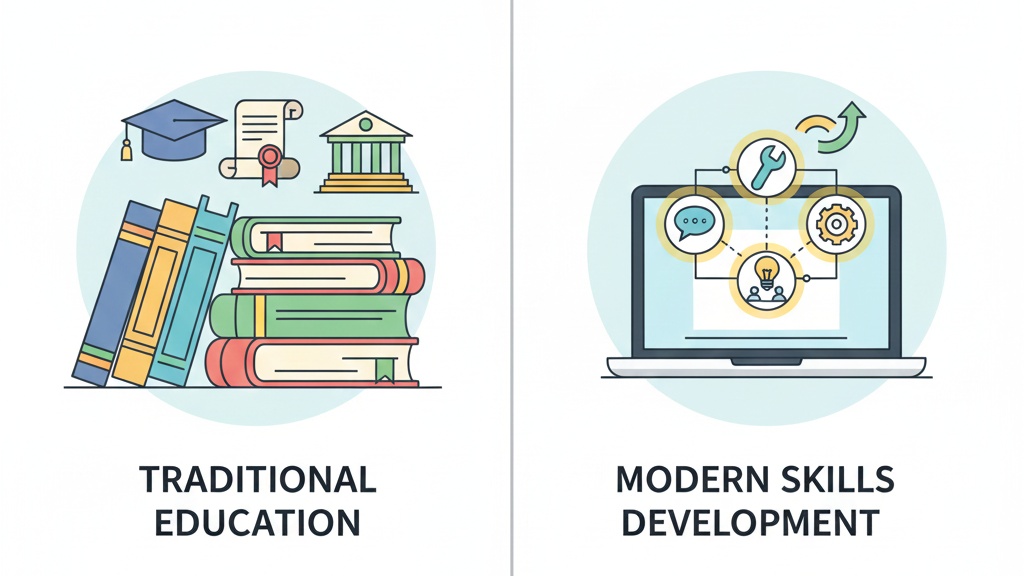
So, which one is better? The truth is, it's not about choosing one and discarding the other. The most successful individuals of the future will be those who learn to blend the best of both worlds. Let's break down how they compare and complement each other. 🧠
The Core Differences at a Glance
| Aspect | Traditional Education | Skill-Based Education |
|---|---|---|
| Primary Focus | Knowledge & Theory | Application & Practice |
| Learning Pace | Fixed, semester-based | Flexible, self-paced |
| Assessment | Exams & Grades | Projects & Portfolios |
| Goal | Earning a Degree | Mastering a Skill |
| Environment | Classroom-based | Real-world, Online, Workshops |
The Synergy: How They Work Together ✨
Imagine a young aspiring doctor. Traditional education gives them the crucial theoretical knowledge of anatomy, diseases, and medical ethics. This is non-negotiable and absolutely vital. But what if, alongside this, they also learn data analysis? They could use this skill to interpret medical research more effectively or contribute to public health data projects. That's the power of synergy!
- Foundation + Application: Use traditional education to build a strong base in subjects like math or science. Then, use skill-based learning to apply that knowledge. For example, a student studying physics could learn Arduino programming to build their own electronic gadgets.
- Degree + Portfolio: A degree gets your foot in the door, but a portfolio of projects gets you the job. A commerce student might have a traditional B.Com degree, but their skill-based learning in digital marketing (perhaps through a certification course) and a portfolio of successful social media campaigns makes them a star candidate.
- Critical Thinking + Action: Traditional education often hones your critical thinking and analytical skills. Skill-based education teaches you how to turn those thoughts into action. You learn to not just solve a math problem on paper, but to use that math to build a budgeting app.
Practical Tip for Indian Students 💡
Don't wait for your formal education to teach you skills. Start now!
- During your semester break: Instead of just relaxing, pick one skill. Want to be a writer? Start a blog. Interested in coding? Dedicate a month to a Python basics course online.
- Use your college resources: Many colleges have clubs for debating, coding, or entrepreneurship. Join them! They are a fantastic bridge between theory and practice.
- Talk to professionals: Find people on LinkedIn who have the job you want. Ask them what skills they use daily. This will give you a clear roadmap for your skill-based learning journey.
The Future is Hybrid: Your Path Forward
The debate isn't about which system will win. It's about how you, as a learner, can navigate this new landscape to your advantage. The future of education is a beautiful blend of deep knowledge and sharp skills. Employers are no longer just looking for a degree; they're looking for problem-solvers, creators, and individuals who can add value from day one. 🎯
Your goal should be to become a T-shaped professional. The vertical bar of the "T" represents your deep knowledge in one core area (from your traditional education). The horizontal bar represents your broad set of skills that allow you to collaborate across different fields (from your skill-based learning). This combination makes you incredibly versatile and valuable.
Key Takeaways
- Traditional Education provides the essential theoretical foundation, discipline, and recognized credentials that form the base of your career. 🎓
- Skill-Based Education focuses on practical, hands-on abilities that make you job-ready, adaptable, and innovative in the real world. 🚀
- The real magic happens when you blend both. Use your formal education to build a strong knowledge base and actively pursue skill-based learning to apply that knowledge and stand out. ✨
- Take ownership of your learning journey. Don't be a passive student. Be an active, curious learner who is always ready to explore, build, and grow. 🌱
Conclusion: Your Education, Your Responsibility
Ultimately, the "best" education is the one that empowers you to achieve your dreams. The world doesn't need more people who can just pass exams; it needs people who can build, create, and solve real-world problems. By understanding the strengths of both traditional and skill-based education, you can craft a learning path that is uniquely yours.
Embrace the structure and knowledge of your formal studies, but never stop there. Be hungry for practical skills. Explore your curiosity. The journey of learning is lifelong, and the most exciting parts happen when you take the driver's seat. You have the power to shape your future. Go out there and build it! 💪
Ready to Build Your Skills?
Feeling inspired to start your skill-building journey but not sure where to begin? We get it! Navigating the world of online courses and learning resources can be overwhelming.
At BandhanNova AI Hub, we're here to be your mentor and guide. Our platform is designed to help students like you discover your potential and connect with resources that can help you learn the skills of tomorrow. Whether you're looking to explore new technologies, develop creative talents, or understand career paths, we provide the tools and guidance to help you succeed.
Start exploring your potential today. Visit BandhanNova AI Hub and take the first step towards becoming a future-ready leader! ✨